Citaciones
Epidemiología molecular: el papel del Atlas del Genoma del Cáncer a lo largo de la historiaa
Molecular epidemiology: the role of the Cancer Genome Atlas throughout history
Abrir | Descargar
Cómo citar
1.
Zarama-Valenzuela Álvaro, Ballen D-F, Rey-Vargas L, Montero-Ovalle W, Huertas-Caro C, Serrano-Gómez S. Epidemiología molecular: el papel del Atlas del Genoma del Cáncer a lo largo de la historiaa. Rev. colomb. hematol. oncol. [Internet]. 2026 Feb. 17 [cited 2026 Feb. 17];13(1-Supl):72-84. https://doi.org/10.51643/22562915.843
Descargar cita




Sección
Revisiones
Cómo citar
1.
Zarama-Valenzuela Álvaro, Ballen D-F, Rey-Vargas L, Montero-Ovalle W, Huertas-Caro C, Serrano-Gómez S. Epidemiología molecular: el papel del Atlas del Genoma del Cáncer a lo largo de la historiaa. Rev. colomb. hematol. oncol. [Internet]. 2026 Feb. 17 [cited 2026 Feb. 17];13(1-Supl):72-84. https://doi.org/10.51643/22562915.843

Dimensions
Licencia

Esta obra está bajo una licencia internacional Creative Commons Atribución-NoComercial-SinDerivadas 4.0.


Mostrar biografía de los autores





Introducción: el Atlas del Genoma del Cáncer (TCGA) ha sido un proyecto colaborativo internacional y multiinstitucional diseñado para caracterizar de manera integral las alteraciones moleculares de tumores de alta relevancia clínica. Este trabajo resume sus principales aportes, así como las limitaciones y retos derivados de su implementación.
Métodos: se realizó una búsqueda estructurada en PubMed, EMBASE y Web of Science sobre TCGA, incluyendo publicaciones relacionadas con sus resultados, metodología, limitaciones y repercusiones clínicas y traslacionales.
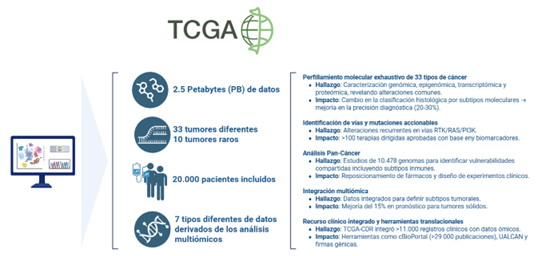
Resultados: se identificaron 88 publicaciones relevantes. TCGA analizó más de 20.000 muestras correspondientes a 33 tipos tumorales, integrando datos genómicos, transcriptómicos, epigenómicos y proteómicos. Entre sus contribuciones más relevantes destacan: a) la redefinición de la clasificación tumoral mediante subtipos moleculares, b) la identificación de mutaciones y vías de señalización con impacto terapéutico, como IDH1 en gliomas y subtipos moleculares en cáncer de mama, endometrio y estómago, c) la validación de biomarcadores pronósticos y predictivos, y d) el desarrollo de bases de datos abiertas que impulsaron estudios traslacionales y ensayos clínicos tipo canasta. En 2018, el Pan-cáncer Atlas evidenció similitudes moleculares transtumorales y consolidó el concepto de “genoma teranóstico”. Persisten limitaciones relacionadas con la representatividad poblacional, la heterogeneidad clínica y la aplicabilidad en entornos con recursos limitados.
Conclusión: TCGA representó un hito en la oncología de precisión al transformar la comprensión de la biología tumoral y sentar las bases para el desarrollo de terapias dirigidas. Sus datos continúan siendo un recurso central para la investigación oncológica global.
Visitas del artículo 0 | Visitas PDF 0
Descargas
Los datos de descarga todavía no están disponibles.
- Salaverry O. Cancer etymology and its historical curious course. Rev Peru Med Exp Salud Publica [Internet]. 2013;30(1):137-141. Disponible en: https://doi.org/10.1590/s1726-46342013000100026.
- Hanahan D. Hallmarks of Cancer: New Dimensions. Cancer Discov [Internet]. 2022;12(1):31-46. Disponible en: https://doi.org/10.1158/2159-8290.CD-21-1059.
- Watson JD, Cook-Deegan RM. Origins of the Human Genome Project. FASEB J [Internet]. 1991;5(1):8-11. Disponible en: https://doi.org/10.1096 fasebj.5.1.1991595.
- Chin L, Gray JW. Translating insights from the cancer genome into clinical practice. Nature [Internet]. 2008;452(7187):553-563. Disponible en: https://doi.org/10.1038/nature06914.
- Wang Z, Jensen MA, Zenklusen JC. A Practical Guide to The Cancer Genome Atlas (TCGA). Methods Mol Biol [Internet]. 2016;1418:111-141. Disponible en: https://doi.org/10.1007/978-1-4939-3578-9_6.
- Hutter C, Zenklusen JC. The Cancer Genome Atlas: Creating Lasting Value beyond Its Data. Cell [Internet]. 2018;173(2):283-285. Disponible en: https://doi.org/10.1016/j.cell.2018.03.042.
- Tomczak K, Czerwińska P, Wiznerowicz M. The Cancer Genome Atlas (TCGA): an immeasurable source of knowledge. Contemp Oncol (Pozn) [Internet]. 2015;19(1A):A68-77. Disponible en: https://doi.org/10.5114/wo.2014.47136.
- Weinstein JN, Collisson EA, Mills GB, Mills-Shaw KR, Ozenberger BA, Ellrott K. The Cancer Genome Atlas Pan-Cancer analysis project. Nat Genet. [Internet] 2013;45(10):1113-1120. Disponible en: https://doi.org/10.1038/ng.2764.
- National Cancer Institute. The Cancer Genome Atlas Program (TCGA) [Internet]. 2025. Disponible en: https://www.cancer.gov/ccg/research/genome-sequencing/tcga
- Eren K, Taktakoglu N, Pirim I. DNA Sequencing Methods: From Past to Present. Eurasian J Med [Internet]. 2022;54(Suppl 1):S47-S56. Disponible en: https://doi.org/10.5152/eurasianjmed.2022.22280.
- Li Y, Kang K, Krahn JM, Croutwater N, Lee K, Umbach DM et al. A comprehensive genomic pan-cancer classification using The Cancer Genome Atlas gene expression data. BMC Genomics [Internet]. 2017;18(1):508. Disponible en: https://doi.org/10.1186/s12864-017-3906-0.
- Ganinin C, Amelio I, Bertolo R, Bove P, Buonomo OC, Candi E et al. Global mapping of cancers: The Cancer Genome Atlas and beyond. Mol Onc [Internet]. 2021; 15(11):2823-2840. Disponible en: https://doi.org/10.1002/1878-0261.13056.
- Cooper LA, Demicco EG, Satlz JH, Powell RT, Rao A, Lazar AJ. PanCancer insights from The Cancer Genome Alas: the pathologist’s perspective. J Pathol [Internet]. 2018;244(5):512-524. Disponible en: https://doi.org/10.1002/path.5028.
- Cancer Genome Atlas Network. Comprehensive molecular portraits of human breast tumours. Nature [Internet]. 2012;490(7418):61-70. Disponible en: https://doi.org/10.1038/nature11412.
- Chang JTH, Lee YM, Huang RS. The impact of the Cancer Genome Atlas on lung cancer. Transl Res [Internet]. 2015;166(6):568-85. Disponible en: https://doi.org/10.1016/j.trsl.2015.08.001.
- Xu X, Jané P, Taelman V, Jané E, Dumont RA, Garama Y et al. The Theranostic Genome. Nat Commun [Internet]. 2024;15(1):10904. Disponible en: https://doi.org/10.1038/s41467-024-55291-x.
- Dittrich C. Basket trials: From tumour gnostic to tumour agnostic drug development. Cancer Treatment Reviews [Internet]. 2020;90:102082. Disponible en: https://doi.org/10.1016/j.ctrv.2020.102082.
- Nagashima T, Yamaguchi K, Urakami K, Shimoda Y, Ohnami S, Ohshima K. Japanese version of The Cancer Genoma Atlas, JCGA, established using fresh frozen tumors obtained from 5143 cancer patients. Cancer Sci [Internet]. 2020;111(2):687-699. Disponible en: https://doi.org/10.1111/cas.14290.
- The future of cancer genomics. Nat Med [Internet]. 2015;21(2):99. Disponible en: https://doi.org/10.1038/nm.3801.
Tutoriales
Información
Directorios e indexadores









Verificación de plagio

Descriptor

Perfil de Google Scholar
Código QR
Palabras clave
Más leídos en los últimos 30 días