Citations
Molecular epidemiology: the role of the Cancer Genome Atlas throughout history
Epidemiología molecular: el papel del Atlas del Genoma del Cáncer a lo largo de la historiaa
Open | Download
How to Cite
1.
Zarama-Valenzuela Álvaro, Ballen D-F, Rey-Vargas L, Montero-Ovalle W, Huertas-Caro C, Serrano-Gómez S. Molecular epidemiology: the role of the Cancer Genome Atlas throughout history. Rev. colomb. hematol. oncol. [Internet]. 2026 Feb. 17 [cited 2026 Feb. 18];13(1-Supl):72-84. https://doi.org/10.51643/22562915.843
Download Citation




Section
Revisiones
How to Cite
1.
Zarama-Valenzuela Álvaro, Ballen D-F, Rey-Vargas L, Montero-Ovalle W, Huertas-Caro C, Serrano-Gómez S. Molecular epidemiology: the role of the Cancer Genome Atlas throughout history. Rev. colomb. hematol. oncol. [Internet]. 2026 Feb. 17 [cited 2026 Feb. 18];13(1-Supl):72-84. https://doi.org/10.51643/22562915.843

Dimensions
license

This work is licensed under a Creative Commons Attribution-NonCommercial-NoDerivatives 4.0 International License.


Show authors biography





Background: the Cancer Genome Atlas (TCGA) was a large international, multi-institutional initiative designed to comprehensively characterize the molecular landscape of clinically relevant human cancers. This review summarizes its major contributions, as well as the limitations and challenges arising from its implementation.
Methods: a structured literature search was conducted in PubMed, EMBASE, and Web of Science to identify publications related to TCGA, including studies reporting its results, methodological approaches, limitations, and clinical and translational implications.
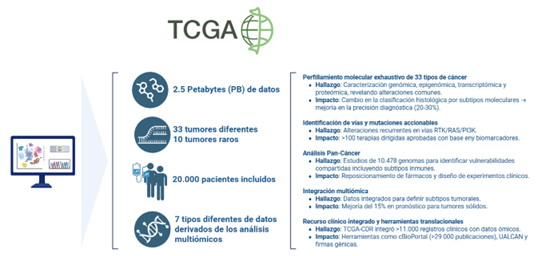
Results: eighty-eight relevant publications were identified. TCGA analyzed more than 20.000 tumor samples across 33 cancer types, integrating genomic, transcriptomic, epigenomic, and proteomic data. Major contributions include: a) redefinition of tumor classification through molecular subtyping; b) identification of oncogenic pathways and actionable alterations with therapeutic relevance, such as IDH1 mutations in gliomas and molecular subtypes in breast, endometrial, and gastric cancers; c) validation of prognostic and predictive biomarkers; and d) development of open-access genomic databases that enabled translational research and basket-type clinical trials. In 2018, the Pan-cáncer Atlas revealed shared biological features across tumor types, reinforcing a genome-driven, theragnostic framework. Limitations include population under-representation, clinical data heterogeneity, and barriers to implementation in resource-limited settings.
Conclusions: TCGA represented a landmark in precision oncology by transforming the understanding of tumor biology and facilitating the development of targeted therapeutic strategies. Its datasets remain a foundational resource for global cancer research and translational innovation.
Article visits 0 | PDF visits 0
Downloads
Download data is not yet available.
- Salaverry O. Cancer etymology and its historical curious course. Rev Peru Med Exp Salud Publica [Internet]. 2013;30(1):137-141. Disponible en: https://doi.org/10.1590/s1726-46342013000100026.
- Hanahan D. Hallmarks of Cancer: New Dimensions. Cancer Discov [Internet]. 2022;12(1):31-46. Disponible en: https://doi.org/10.1158/2159-8290.CD-21-1059.
- Watson JD, Cook-Deegan RM. Origins of the Human Genome Project. FASEB J [Internet]. 1991;5(1):8-11. Disponible en: https://doi.org/10.1096 fasebj.5.1.1991595.
- Chin L, Gray JW. Translating insights from the cancer genome into clinical practice. Nature [Internet]. 2008;452(7187):553-563. Disponible en: https://doi.org/10.1038/nature06914.
- Wang Z, Jensen MA, Zenklusen JC. A Practical Guide to The Cancer Genome Atlas (TCGA). Methods Mol Biol [Internet]. 2016;1418:111-141. Disponible en: https://doi.org/10.1007/978-1-4939-3578-9_6.
- Hutter C, Zenklusen JC. The Cancer Genome Atlas: Creating Lasting Value beyond Its Data. Cell [Internet]. 2018;173(2):283-285. Disponible en: https://doi.org/10.1016/j.cell.2018.03.042.
- Tomczak K, Czerwińska P, Wiznerowicz M. The Cancer Genome Atlas (TCGA): an immeasurable source of knowledge. Contemp Oncol (Pozn) [Internet]. 2015;19(1A):A68-77. Disponible en: https://doi.org/10.5114/wo.2014.47136.
- Weinstein JN, Collisson EA, Mills GB, Mills-Shaw KR, Ozenberger BA, Ellrott K. The Cancer Genome Atlas Pan-Cancer analysis project. Nat Genet. [Internet] 2013;45(10):1113-1120. Disponible en: https://doi.org/10.1038/ng.2764.
- National Cancer Institute. The Cancer Genome Atlas Program (TCGA) [Internet]. 2025. Disponible en: https://www.cancer.gov/ccg/research/genome-sequencing/tcga
- Eren K, Taktakoglu N, Pirim I. DNA Sequencing Methods: From Past to Present. Eurasian J Med [Internet]. 2022;54(Suppl 1):S47-S56. Disponible en: https://doi.org/10.5152/eurasianjmed.2022.22280.
- Li Y, Kang K, Krahn JM, Croutwater N, Lee K, Umbach DM et al. A comprehensive genomic pan-cancer classification using The Cancer Genome Atlas gene expression data. BMC Genomics [Internet]. 2017;18(1):508. Disponible en: https://doi.org/10.1186/s12864-017-3906-0.
- Ganinin C, Amelio I, Bertolo R, Bove P, Buonomo OC, Candi E et al. Global mapping of cancers: The Cancer Genome Atlas and beyond. Mol Onc [Internet]. 2021; 15(11):2823-2840. Disponible en: https://doi.org/10.1002/1878-0261.13056.
- Cooper LA, Demicco EG, Satlz JH, Powell RT, Rao A, Lazar AJ. PanCancer insights from The Cancer Genome Alas: the pathologist’s perspective. J Pathol [Internet]. 2018;244(5):512-524. Disponible en: https://doi.org/10.1002/path.5028.
- Cancer Genome Atlas Network. Comprehensive molecular portraits of human breast tumours. Nature [Internet]. 2012;490(7418):61-70. Disponible en: https://doi.org/10.1038/nature11412.
- Chang JTH, Lee YM, Huang RS. The impact of the Cancer Genome Atlas on lung cancer. Transl Res [Internet]. 2015;166(6):568-85. Disponible en: https://doi.org/10.1016/j.trsl.2015.08.001.
- Xu X, Jané P, Taelman V, Jané E, Dumont RA, Garama Y et al. The Theranostic Genome. Nat Commun [Internet]. 2024;15(1):10904. Disponible en: https://doi.org/10.1038/s41467-024-55291-x.
- Dittrich C. Basket trials: From tumour gnostic to tumour agnostic drug development. Cancer Treatment Reviews [Internet]. 2020;90:102082. Disponible en: https://doi.org/10.1016/j.ctrv.2020.102082.
- Nagashima T, Yamaguchi K, Urakami K, Shimoda Y, Ohnami S, Ohshima K. Japanese version of The Cancer Genoma Atlas, JCGA, established using fresh frozen tumors obtained from 5143 cancer patients. Cancer Sci [Internet]. 2020;111(2):687-699. Disponible en: https://doi.org/10.1111/cas.14290.
- The future of cancer genomics. Nat Med [Internet]. 2015;21(2):99. Disponible en: https://doi.org/10.1038/nm.3801.
Tutorials
About the journal
Information
Directories and Indexers









Plagiarism Check

Descriptor

Google Scholar profile
QR code
Keywords
Most read in the last 30 days